
Wiring Repair and Rewiring in Columbus
Wiring trouble usually starts small. A light flickers, an outlet stops working, a breaker trips at the same time every evening. Each one has a cause, often a loose connection, a worn device or wiring that has reached the end of its life, and finding that cause is most of the job.
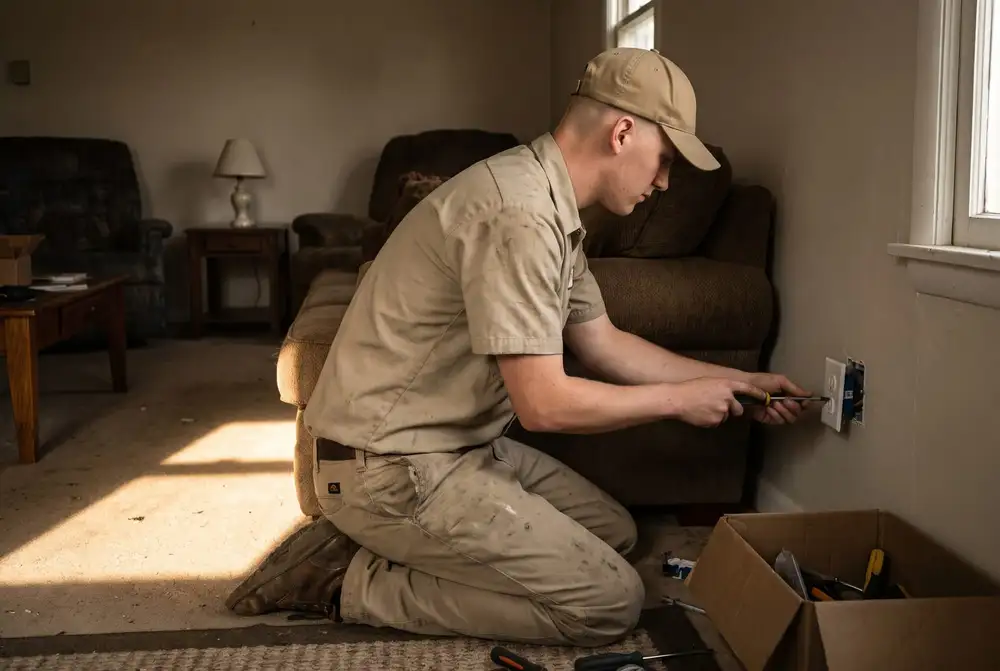
The search starts at the panel and works back from the dead outlet or fixture, so the repair lands on the fault, not the symptom. Most fixes are small: a connection remade, a scorched outlet replaced, a damaged run of cable swapped out. Where a building still depends on wiring that can no longer be trusted, such as knob-and-tube or brittle cloth-covered cable, the better answer is a partial or full rewire, planned circuit by circuit.
What Failing Wiring Looks, Smells and Sounds Like
- Lights that flicker or dim, especially when the air conditioner, the furnace blower or the microwave starts
- Outlets, switches or cover plates that feel warm
- A burning or hot-plastic smell with no obvious source
- Buzzing or crackling at a switch, an outlet or a fixture
- Scorch marks or brown discoloring around an outlet
- Ungrounded two-prong outlets, or three-prong ones with no ground behind them
- Breakers that trip often, or fuses that keep blowing
- Outlets or lights that quit for no clear reason
Some of these are a nuisance and some are a warning. A brief dip in the lights as a big motor starts can be normal. A deep or lasting dim, or lights that brighten while others dim, points to a loose neutral, a fault that can damage appliances and should be fixed soon.
Our dining room light would dim every time the AC kicked on, so we had Frank take a look. He checked the panel and found a loose neutral and tightened everything up. He explained why a big motor starting can show up as dimming elsewhere in the house. Really knowledgeable. No issues since. Punctual and easy to deal with.
Heat, Smoke or Sparks Come First
An outlet that is hot to the touch, smoking or sparking, or a burning smell you can trace to a wall, is one of the electrical emergencies that should not wait for a quote. Stop using it and, if the panel is safe to reach, switch that circuit’s breaker off. If there is smoke or flame, get everyone out and call 911.
Wiring Types by the Age of the Building
The age of a building says a lot about what is behind its walls. In the oldest houses of Victorian Village and German Village, knob-and-tube wiring can still run inside the walls, often spliced into later cable. Mid-century houses tend to have cloth-sheathed cable or ungrounded circuits, and some houses and apartments from the late 1960s and early 1970s were wired with aluminum.
| Wiring type | Typical era | Known concern | Usual approach |
|---|---|---|---|
| Knob-and-tube | Roughly before the 1940s | No ground wire, aging insulation, and never meant to sit under insulation or carry modern loads | Replace it circuit by circuit; until then, add no new loads and keep insulation off it |
| Cloth-sheathed cable | 1940s and 1950s | Insulation that turns brittle and cracks, worst near light fixtures, and often no ground | Replace the runs that have gone brittle, or rewire where it is failing throughout |
| Two-wire ungrounded circuits | Common until the 1960s | Two-prong outlets with no ground path, and three-prong outlets added without one | A new grounded circuit, or GFCI protection with each outlet marked “No equipment ground” |
| Aluminum branch wiring | About 1965 to 1973 | Connections that loosen and overheat at outlets, switches and splices | Rated connectors such as AlumiConn or COPALUM at every connection, or a rewire in copper |
| Backstabbed outlets | Builder-grade outlets, still sold today | Push-in contacts that loosen over time, then heat and burn | Move the wires to the screw terminals or replace the outlet |
Repair or Rewire: How the Choice Gets Made
A repair fits when the fault is local: one loose connection, a burned outlet, a run of cable damaged by a nail or a rodent. Fix it, test the circuit, and the problem is gone.
A rewire fits when the wiring itself is the problem. Knob-and-tube, brittle cloth insulation and repeated faults across several circuits all point the same way, because fixing one spot leaves the next one waiting. A partial rewire takes on the worst of it, often a kitchen, an upstairs or the oldest circuits; a full rewire replaces the lot.
New wiring follows current code wherever it runs: grounded outlets, GFCI protection in kitchens, baths and other damp areas, and AFCI protection on most living-area circuits. It is also the moment to look at the panel, since new circuits need spaces and capacity, and an old fuse box is better replaced in the same project with a panel upgrade.
What does a rewire involve?
A plan for the circuits, a permit from the city, then new cable run from the panel to each outlet, switch and light. The old wiring is disconnected and taken out where it can be reached. An inspector checks the work, usually once while the new wiring is still visible and again when it is finished.
Can a house be rewired without opening up every wall?
Mostly. New cable gets fished through the walls from the attic and the basement, with small openings cut where a run has to turn or cross framing. Plaster and lath, common in older houses, takes more care than drywall, and those openings need patching afterward.
Is aluminum wiring dangerous?
The wire itself is not the weak spot; the connections are. Aluminum expands, contracts and oxidizes more than copper, so terminals loosen and heat up over the years. Each connection can be repaired with connectors rated for aluminum, such as AlumiConn or COPALUM, or the circuits can be rewired in copper. Ordinary twist-on wire connectors are not a fix.
Does knob-and-tube wiring have to come out?
Not all at once, but it should not be extended, loaded with new appliances or buried in insulation, and it gives modern electronics no ground. Many owners replace it in stages, starting with the busiest rooms. Home inspectors flag it, so it often comes up when a house is bought or sold.
Will a three-prong adapter fix a two-prong outlet?
No. The adapter fits the plug but adds no ground. The real choices are a new grounded circuit, or GFCI protection, which guards people against shock even without a ground, with each outlet labeled “No equipment ground” so nobody mistakes it for a grounded one. Surge protectors and some electronics still need a true ground.
Rewiring a House People Live In
A rewire rarely needs an empty house. Working one circuit or one floor at a time keeps the rest of the house powered, and the circuits that matter most day to day, such as the refrigerator and the furnace, can stay on while others are switched over.
Landlords face the same job with tenants in place. A rental unit with two-prong outlets, a fuse box or scorched devices is easiest to deal with between tenants, when the rooms are empty, or in stages around the people living there. The same repair-or-rewire choice comes up in small commercial spaces, with business hours to plan around.
Find the Fault Behind the Symptom
A light that dims, an outlet that went dead or a house still on old wiring: describe what you are seeing and when it started.