
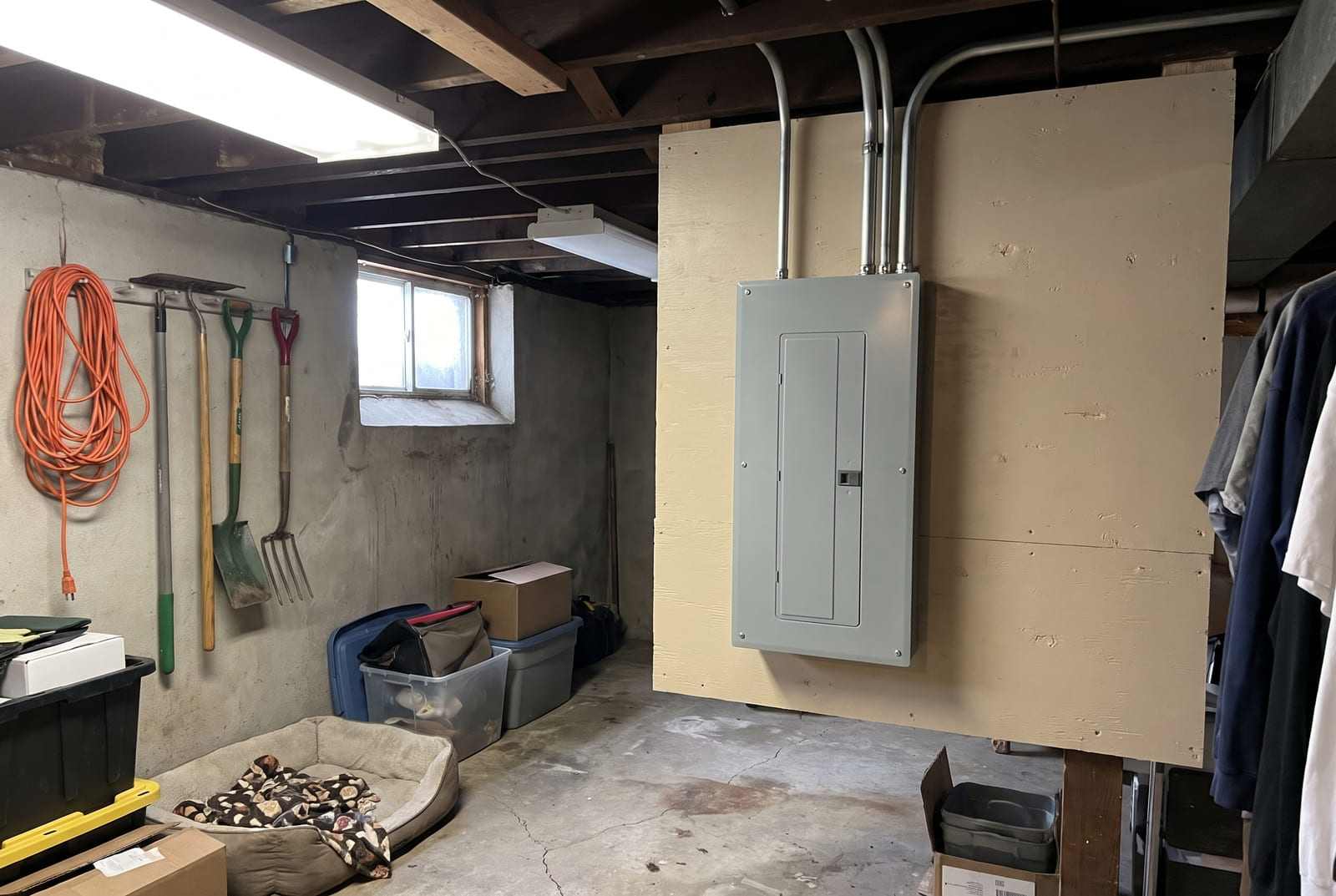
Panel Upgrades in Columbus
Panel upgrades are most of the work at Polaris Electric. The panel is where power enters the building and splits into circuits, and in an older house it is often the weak point: sized for lamps, a refrigerator and a washing machine, then asked to run central air, an electric dryer and a kitchen full of appliances.
Plenty of Columbus houses are in that position. Brick homes in German Village and Victorian Village and mid-century houses in Clintonville and Whitehall still turn up screw-in fuses and 100-amp panels. Replacing one gives the house the capacity it needs now, room for what it adds later, and breakers that trip when they should.
A New Panel or a Bigger Service
“Panel upgrade” covers two different jobs. A panel replacement swaps the box of breakers at the same size, which settles a fuse box, a failing brand or a panel with no spaces left. A service upgrade raises the amps the house can draw: a new meter base, heavier cable from the utility’s connection and a larger main breaker, along with the new panel.
Which one a house needs comes down to capacity. A 100-amp house adding central air and an electric range needs the bigger service; a 200-amp house with a worn-out panel may need only the new box.
Signs a Fuse Box or Panel Has Reached Its Limit
A panel rarely fails without warning. Most of the signs show up in daily life, long before anyone opens the cover.
- Breakers that trip often, especially when the air conditioner, a space heater or the microwave starts.
- Fuses that keep blowing, or a fuse box where larger fuses have been fitted to stop them blowing.
- Buzzing, crackling or a warm cover at the panel, or scorch marks around a breaker.
- Lights that dim every time a large appliance kicks on.
- A large appliance on the way, such as an electric range, a heat pump, an EV charger or a hot tub.
- No spaces left for new circuits, or a panel crowded with tandem breakers and two wires under one screw.
- An older fuse box, or a Federal Pacific Stab-Lok or Zinsco panel, two brands with a record of breakers that fail to trip.
One sign on its own does not always mean a new panel. A single warm breaker can come down to a loose connection, and fixing it can be the whole job. A panel that is full, fused or short of capacity for what the house now runs is a different matter: that is when an upgrade earns its place.
Lights in the kitchen kept flickering and one breaker was warm to the touch. Called and the electrician came out the same afternoon. Found a loose connection on the breaker and some scorching on the wire end. He cut it back, put in a new breaker and checked the rest of the panel while he had the cover off. Told me the panel itself was fine for now. No upsell. Quick and glad it got caught.
A panel that feels hot or smells of burning is not a sign to wait on. Treat it as one of the electrical emergencies, keep clear of it and call.
Service Sizes and What Each One Carries
Panels are rated in amps, and the rating caps how much power the house can draw at once. The right size comes from adding up the loads, not from square footage alone, but most houses land in one of these ranges.
| Panel size in amps | Typical home use | Good fit when | Things to consider |
|---|---|---|---|
| 60 A | Houses from before about 1960, often on screw-in fuses | Feeding a garage or workshop as a subpanel, not a whole house | Too small for central air or most electric appliances, so usually replaced outright |
| 100 A | Smaller houses that heat, cook and dry clothes with gas | The house is modest, the big appliances run on gas and no large loads are planned | Central air with an electric dryer and range can push it past its limit, and it leaves little room for a charger |
| 150 A | Mid-size houses with central air and one or two electric appliances | A step up is needed, but the loads stay moderate | Check that it leaves room for a charger or a heat pump before settling on it |
| 200 A | Most houses built or upgraded today | Central air, electric cooking and drying, with space for a charger or a heat pump | Coming up from 100 A usually means a new meter base and heavier service cable |
| 320–400 A | Large all-electric houses | Electric heat, several large appliances, a charger and a hot tub all at once | The utility has to supply the larger service, and a load calculation should confirm it |
Where a house lands depends on what runs at the same time. A load calculation adds up the lighting, the appliances, the heating and cooling and anything planned, and it sets the size before a panel is chosen.
Panel Sizing Guide
A first look at the amp range a house is likely to need, from its size and its big electric loads.
Choose the home size and tick its major loads, then press Show the Range.
Swapping the Panel, Step by Step
A panel upgrade is planned work, and most of the planning happens before the day the power goes off.
- Size and layout. The load calculation sets the amp rating, and the circuits get counted so the new panel has spaces to spare. The panel needs clear working space in front of it, which rules out spots such as a clothes closet or a bathroom.
- Permit. A panel or service change normally needs a permit from the city where the house sits. Columbus, Bexley, Grandview Heights, Upper Arlington and Worthington each run their own building department.
- Power off. The power stays off while the panels are swapped. A service change also needs the utility to disconnect the house and reconnect it.
- The swap. The old panel comes out and the new one goes in. Each circuit lands on a breaker matched to its wire, the grounding and bonding are brought up to current requirements, and every breaker gets labeled.
- Inspection. An inspector from the city checks the finished work.
When is it time to upgrade instead of repairing the old panel?
When the panel is a fuse box, a brand with a known breaker problem, out of spaces, or too small for what the house runs or will run. A loose connection or one worn breaker is a repair. Damage to the bus bars, the metal strips the breakers clip onto, usually means a new panel.
Does a panel upgrade need a permit and an inspection?
Normally, yes. The change goes through the building department of the city where the house sits, and an inspector checks the finished work. That puts a second set of eyes on the part of the system everything else depends on.
How long is the power off?
Plan on most of a day without power for a straight panel swap. A service change, with a new meter base or new service cable, also depends on when the utility can disconnect and reconnect the house. A closed refrigerator stays cold for hours; anything that needs constant power, such as medical equipment, needs a plan before the day.
Can new circuits be added without a new panel?
Often. If the panel has open spaces and the load calculation shows spare capacity, a new circuit goes straight in. A panel short of spaces but not of capacity can take a subpanel. A panel short of capacity needs a smaller load, such as a charger set to a lower current, or an upgrade. Tandem breakers only go in panels listed for them.
Is a 200-amp panel always the answer?
No. A modest house that cooks and heats with gas may be well served by 100 or 150 amps, and a large all-electric house may need more than 200. The load calculation settles it, not habit.
What Opening an Old Panel Often Turns Up
An old panel has been closed up for decades, and so has the wiring around it. Frank Holcomb has swapped out plenty of fuse boxes and small panels, and the job often turns up other problems behind the walls:
- Worn grounding, such as a ground wire still clamped to a water pipe that was later replaced with plastic, or a clamp gone loose and corroded.
- Old splices, taped joints in the basement ceiling or inside boxes, some with the insulation crumbling.
- Oversized fuses or breakers, fitted to stop nuisance trips, which let the wire overheat instead.
- Brittle cloth-covered wire at the panel, a hint of what runs through the walls.
These get fixed while the panel is open, the simplest time to do it, and you hear about each one before it is repaired. Problems that run past the panel and into the walls become a wiring repair job of their own.
Add-Ons That Fit a Panel Job
The first add-on is spare capacity. If an electric car, a heat pump or a kitchen remodel is likely, sizing for it now saves a second upgrade later, and an EV charging circuit can go in with the panel.
Two more fit naturally into the same job. A whole-house surge protector mounts at the new panel and meets a surge where it enters, which matters when Columbus summer thunderstorms roll through. A generator hookup, through an inlet with an interlock or a transfer switch, lets a generator run chosen circuits through a winter outage without feeding power back into the utility’s lines.
Size the Panel Before the Next Appliance Arrives
Planning central air, a new range or a car charger? Find out what the panel can carry before the delivery date.