

GFCI, AFCI and Surge Protection in Columbus
Every circuit in a house has a breaker or a fuse, and on many circuits that is no longer the only protection the electrical code asks for. A standard breaker protects the wire. A GFCI protects people from shock near water. An AFCI protects the house from the small electrical arcs that start fires inside walls. A surge protector protects whatever is plugged in.
Plenty of Columbus houses have none of the newer devices. A 1920s bungalow in Clintonville or a 1950s ranch in Whitehall was wired before GFCI and AFCI protection existed, so its kitchen and bathrooms may still run on plain outlets and plain breakers. Adding the right protection is one of the simplest safety upgrades an older house can get.
Five Kinds of Circuit Protection and Where Each Belongs
Each option answers a different danger, so most homes end up with a mix. GFCI stands for ground-fault circuit interrupter and AFCI for arc-fault circuit interrupter. Both come as breakers for the panel, and as outlets that also protect the outlets wired after them.
| Option | What it protects against | Typical locations | Where it is commonly required | Good fit when |
|---|---|---|---|---|
| Standard breaker | Overloads and short circuits that overheat the wire | In the panel, one for each circuit | On every circuit, matched to the size of its wire | The circuit sits outside the areas newer code covers, such as some hardwired equipment |
| GFCI outlet or breaker | Shock: current leaking to ground through water or a person | Bathrooms, kitchen counters, garages, outdoors, basements and laundry areas | Wet and damp areas, a list that grows with each code edition | Outlets near water, or an old two-prong outlet with no ground wire behind it |
| AFCI breaker | Arcing from crushed cords, loose terminals and nicked cable, a common cause of fires in walls | Bedrooms, living and dining rooms, hallways and closets | Most living-area circuits in newer houses, and often when an older circuit is extended | Rooms where people sleep and relax, and older wiring that is being added to |
| Dual-function AFCI/GFCI breaker | Shock and arcing together, on the whole circuit | Kitchens and laundry areas | Wherever one circuit needs both kinds of protection | One device at the panel is neater than a GFCI outlet on an AFCI circuit |
| Whole-home surge protector | Voltage spikes from lightning, utility switching and large motors cycling | At the main panel, or at the meter | Newer code calls for one when a home’s service is replaced or upgraded | The house has electronics, smart appliances, an EV charger, or a furnace and AC with control boards |
A GFCI and an AFCI don’t stand in for each other, and neither replaces the breaker. Where a circuit needs both, a dual-function breaker covers it in one device, or a GFCI outlet goes on a circuit that already has AFCI protection.
What is the difference between a GFCI and an AFCI?
A GFCI compares the current going out on the hot wire with the current coming back on the neutral. If a few thousandths of an amp go missing, possibly through a person, it cuts the power in a fraction of a second. An AFCI reads the pattern of the current for the crackle of an arc, the kind a crushed cord or a loose screw terminal makes, and shuts the circuit off before the arc can start a fire. One protects people from shock. The other protects the house from fire.
How often should I press the TEST button?
Makers of GFCI outlets and breakers recommend a test about once a month, and AFCI breakers carry their own test button and instructions. Press TEST: the device should click off and the power should cut. Press RESET to bring it back. A device that won’t trip, or won’t reset, has failed and needs replacing. The test takes seconds and fits in with the other checks around the house each season.
Why does my AFCI or GFCI trip when nothing seems wrong?
Often something is wrong, just out of sight: a damaged extension cord, moisture in an outdoor box, or two circuits sharing one neutral wire in an older house, which the newer devices notice. Early AFCIs could also trip on some motors, such as vacuums and treadmills. A device that trips over and over is worth tracing rather than swapping for a plain breaker, and the trace starts with what was running when it tripped.
Do I have to update the outlets in an older house?
Existing wiring that met the code when it went in is generally allowed to stay. The newer rules usually come into play when work is done: replacing an outlet in a place that now calls for GFCI protection, for example, normally means the new one needs that protection. Adding it where it is missing is worth doing either way, starting with kitchens, bathrooms and anything outdoors.
Can a GFCI make an old two-prong outlet safer?
Yes. Where there is no ground wire, a GFCI can replace a two-prong outlet and protect people from shock, labeled “No equipment ground.” It doesn’t add a ground, so surge strips and some electronics plugged into it still lack one. A new grounded circuit is the complete fix.
Picking the Right Device for Each Circuit
A few questions settle most choices.
- Is there water nearby? Kitchen counters, bathrooms, laundry areas, garages, unfinished basements and anything outdoors call for GFCI protection.
- Is it a living space? Bedrooms, living and dining rooms, hallways and closets call for AFCI protection on new and extended circuits.
- Do both apply? Kitchens and laundry areas are the usual places for a dual-function breaker.
- Will the panel take it? AFCI and dual-function breakers are made for specific panel brands. Fuse boxes take no breakers at all, and older panels such as Federal Pacific Stab-Lok and Zinsco have none made for them, which is often the point where an upgraded panel makes sense.
- Where should the protection sit? A breaker protects the whole circuit from the panel on. An outlet-type device protects itself and the outlets after it, and it resets right where you use it.
- What is plugged in? Computers, TVs, appliance control boards and EV chargers all gain from a whole-house surge protector, with plug-in strips at the most sensitive pieces.
Whole-House Surge Protectors and Plug-In Strips
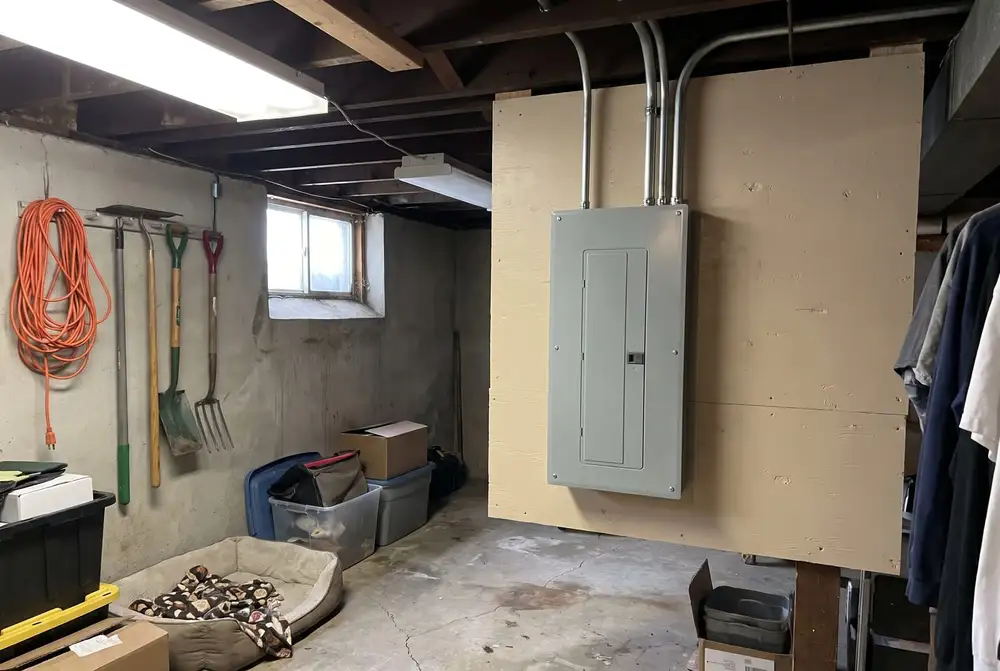
A whole-house surge protector mounts at the main panel, wired in on a breaker of its own. When a spike arrives on the incoming lines, it sends the excess to ground before it can spread through the branch circuits.
Lightning is the obvious source, and Central Ohio’s summer thunderstorms bring plenty of it. Most surges are smaller and far more frequent: the utility switching its lines, or the air conditioner, the furnace blower and the refrigerator starting and stopping. Each small spike wears a little more on the circuit boards in furnaces, appliances, chargers and TVs.
Polaris Electric installs whole-house surge protection, on its own or while a panel is already open for an upgrade. A surge protector only works as well as the grounding behind it, and in older houses the ground wire to the water pipe or the ground rod is often worn, loose or missing.
Plug-in surge strips still earn their place. They catch what gets past the panel unit and the spikes made inside the house, so keep them at computers, TVs and game consoles. Replace a strip after a big hit, or when its protection light goes out.
Add the Protection Your Circuits Are Missing
Tell us which rooms you have in mind, or which breaker keeps tripping. Polaris Electric can add GFCI, AFCI and surge protection to the circuits you have, or plan it into a new panel.