
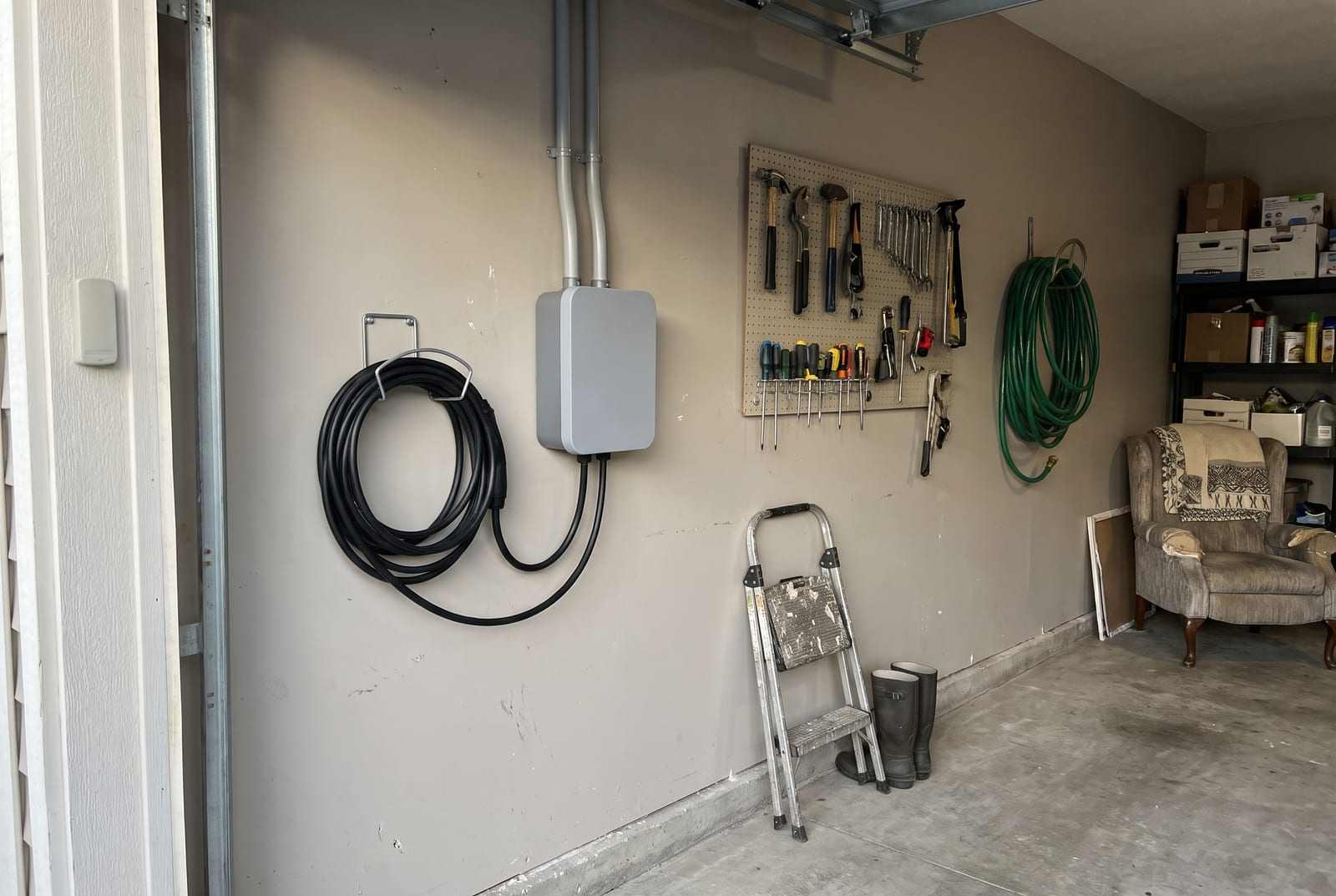
EV Charger Installation in Columbus
An electric car can charge from an ordinary outlet, but slowly. Most drivers who park at home end up with Level 2 charging: a 240-volt circuit of its own, run from the panel to a wall-mounted charger or a heavy-duty outlet beside the parking spot. Plugged in overnight, most cars put back a day’s driving with hours to spare.
The circuit is simple to describe and worth getting right. It has to suit the charger, the length of the run and, above all, the panel that feeds it. The same work applies to a shop or an office adding a charging spot for staff or customers.
Level 1, Level 2 and DC Fast Charging
The three levels differ in voltage, in the circuit they need and in how much range they add for each hour plugged in.
| Level | Voltage | Circuit needed | Typical use | Home requirements |
|---|---|---|---|---|
| Level 1 | 120 V | A standard 15- or 20-amp outlet, ideally on a circuit with little else on it | Plug-in hybrids and short daily drives; a few miles of range per hour | A sound, grounded outlet near the car; usually no new circuit |
| Level 2, plug-in | 240 V | A dedicated 50-amp circuit to a NEMA 14-50 outlet with GFCI protection | Portable chargers and everyday home charging | Room in the panel for a two-pole breaker and the capacity to carry it |
| Level 2, hardwired | 240 V, or 208 V in many commercial buildings | A dedicated 40- to 60-amp circuit for a 32- to 48-amp charger | Higher-power home charging, outdoor spots and workplaces | A load calculation that shows the panel can take it, and outdoor-rated equipment outside |
| DC fast charging | Three-phase commercial power, commonly 480 V | A commercial service and dedicated equipment | Highway stops and fleet lots | Not an option for a house |
Four Things That Shape the Install
- Panel capacity. A charger draws its full current for hours, on top of everything else the house runs. A load calculation shows whether the panel can carry it; where it falls short, the choices are a larger service, a load management device that holds the charger back while the house is busy, or a charger set to a lower current.
- Distance to parking. The farther the spot is from the panel, the longer and heavier the cable. An attached garage beside the panel is the simple case; a detached garage or a post by the driveway usually means a trench, and sometimes a small panel at the far end.
- Outdoor rating. Outside, the charger needs an enclosure rated for wet locations, such as NEMA 3R or NEMA 4, and an outlet needs a weatherproof in-use cover. A holster keeps the connector off the driveway through Columbus winters, when slush and road salt find every gap.
- Permit. A new charging circuit normally needs a permit and an inspection from the city where the building sits. Columbus, Bexley, Grandview Heights, Upper Arlington and Worthington each run their own building department.
For a first idea of whether the house needs more capacity, run its size and big loads through the panel sizing guide.
Why the Charger Gets a Circuit of Its Own
A charger is a continuous load: it can pull its full current for hours at a stretch. The circuit is sized for that, with the breaker rated at 125 percent of the charger’s current, which is why a 32-amp charger sits on a 40-amp circuit and a 48-amp charger on a 60-amp one. Shared with a dryer, a freezer or a run of garage outlets, the same circuit would trip, or worse, run hot.
A dedicated circuit also keeps the job simple to inspect and simple to live with: one breaker, one cable, one charger, and a clear label at the panel.
Polaris put in a dedicated circuit for our new chest freezer in the basement and added a couple outlets down there while they were at it. The electrician told us one spot we wanted wasn't worth the extra run and he was right. Wiring is clean and he labeled the panel before leaving. Showed up on time and never pushed anything. We'll use them for the next project.
Does an EV charger need a dedicated circuit?
A Level 2 charger does: a 240-volt circuit that feeds the charger and nothing else. Level 1 can run from an ordinary outlet, though it does better on a circuit that is not also feeding a freezer or a space heater.
Is my panel big enough for a charger?
That depends on what the house already runs. A 200-amp panel in a house with gas heat usually has room. A 100-amp panel with central air and electric appliances often does not, and the answer then is a larger service, load management or a charger set to a lower current.
Can the charger go outside?
Yes, with equipment rated for outdoor use, mounted clear of where snow gets piled and where a bumper might reach it. Cable and conduit outdoors need protection from damage, and an outdoor outlet needs a weatherproof in-use cover.
Do I need a permit for an EV charger?
A new circuit for a charger normally needs a permit and an inspection from the building department of the city where the house or business sits. The inspection checks the circuit, the breaker and the grounding.
Should the charger plug in or be hardwired?
A plug-in charger on a NEMA 14-50 outlet can be unplugged and taken along, and it tops out at 40 amps of charging. A hardwired charger can run at 48 amps on a 60-amp circuit, has no plug to wear loose, and is often the better choice outdoors.
Charging Spots for Small Workplaces
Small commercial spaces such as shops, offices and restaurants add charging for staff, for customers or for a delivery vehicle. The steps match a home install, with a few differences: the building may run on a 208-volt three-phase service, where a Level 2 charger works at slightly lower power; the runs across a parking lot are longer; and a post or bollard may be needed where cars maneuver.
In a leased space, the landlord’s approval and the building’s spare capacity come first. A load calculation for the whole building, not just one unit, settles whether the service can take another steady load. Charging is planned like any other commercial circuit.
Know Your Panel, Parking Spot and Charger
A few details shape the plan more than anything else. Gather them before the visit, and the first conversation can skip straight to the options.
- The panel’s location, and a photo of its label and main breaker, which shows the amp rating.
- The parking spot, and which side of the car the charge port is on.
- The charger model, if you have chosen one, with its amp rating and whether it plugs in or is hardwired.
- Other plans that add load, such as a heat pump, an induction range or a hot tub.
Send them with your request, or call and talk it through.